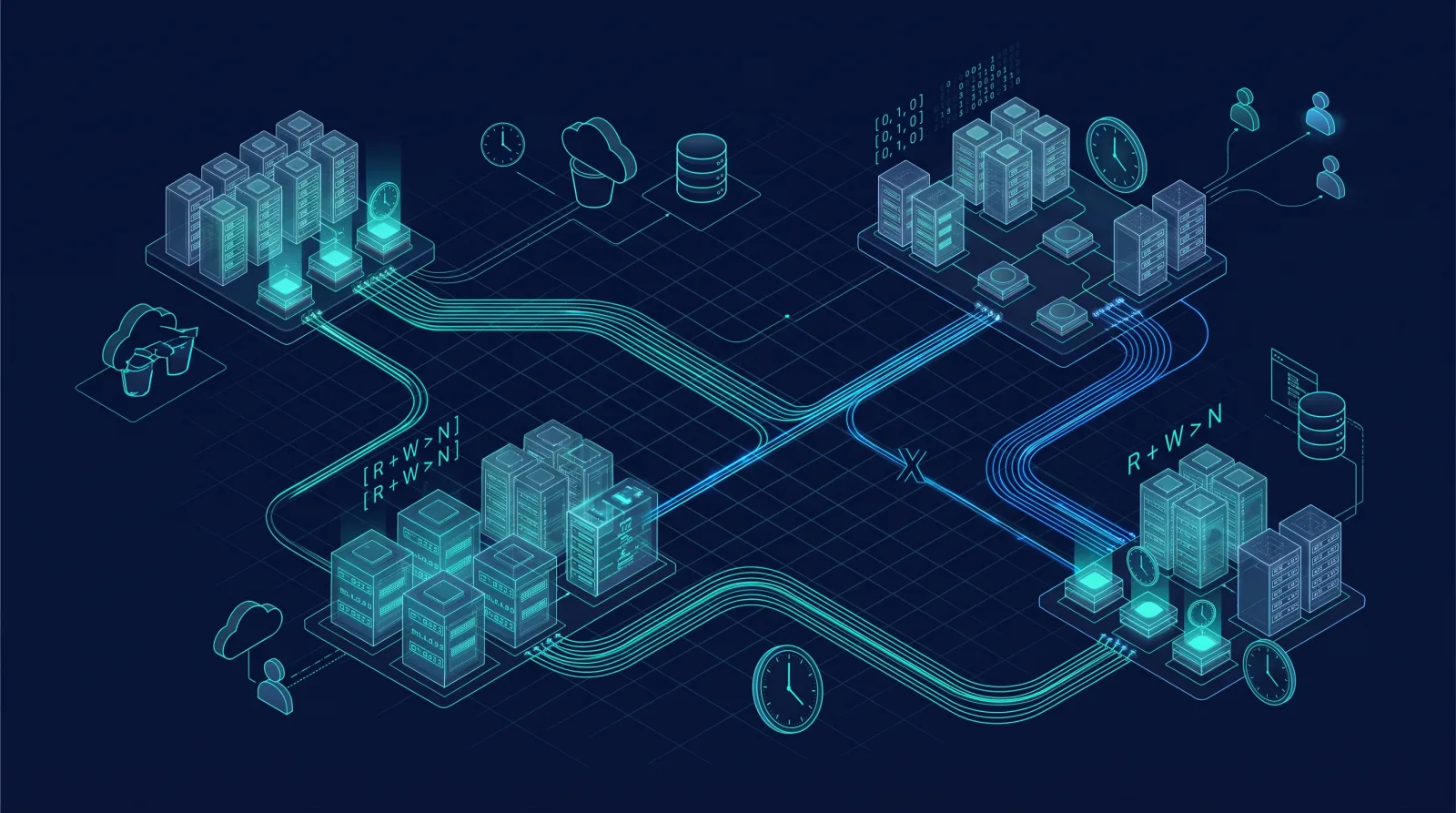
1. The Reality of Distributed Computing: Coordination Over Chaos
distributed system
partial failures
"A distributed system is one in which the failure of a computer you didn't even know existed can render your own computer unusable."
The Two Generals' Problem
- Two army generals camp on hills overlooking an enemy fortress. To win, they must attack simultaneously.
- The only communication route is through the enemy-controlled valley via messengers.
- General 1 sends a message: "Attack at dawn". Because the messenger could be captured, General 1 cannot attack without an acknowledgment.
- General 2 sends an acknowledgment. However, General 2 does not know if that acknowledgment made it back safely, requiring an acknowledgment of the acknowledgment.
100% consensus with absolute certainty is impossible
2. The Challenge of Time: Why Physical Wall Clocks Lie
Clock Drift
network jitter
- The Problem in Practice: If Server A's clock runs 5 milliseconds faster than Server B's, a deposit logged on Server A might receive an earlier timestamp than a withdrawal processed on Server B, corrupting financial ledger logs and transaction sequencing.
- The High-End Cloud Solution: Databases like Google Cloud Spanner resolve this with physical atomic clocks and GPS receivers deployed across datacenters (the TrueTime API), bounding clock uncertainty to less than 7 milliseconds.
3. Logical Time: Lamport Timestamps & Vector Clocks
CausalityDid Event A cause Event B?
Lamport Timestamps (Monotonic Counters)
- Increment the local counter before any local event (
).
- When sending a network message, attach the current counter.
- When receiving a message, advance the local counter:
- Increment the local counter before any local event (
Vector Clocks (Detecting Concurrent Write Collisions)
concurrently
Vector Clocks
- If Server A updates to [2, 0, 0] and Server B updates concurrently to [1, 1, 0], the database notices that Server A has a higher value for A, while Server B has a higher value for B.
- The system detects a concurrent conflict and triggers resolution logic (or presents siblings to the application) instead of silently overwriting user data.
4. The CAP Theorem & The Network Partition Dilemma
[PLACEMENT: In-Article Diagram Image]
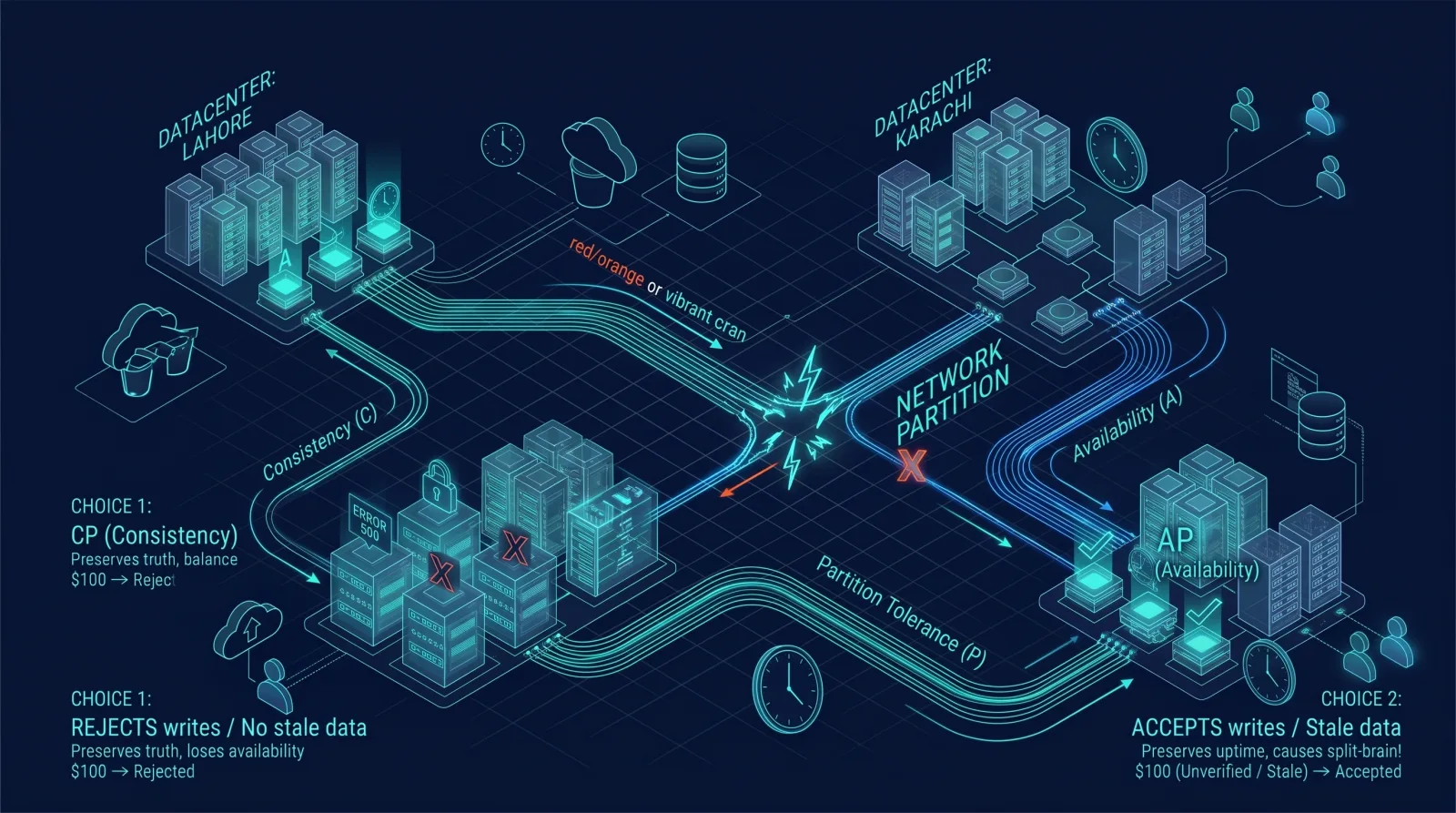
CAP Theorem
- Consistency (C): Every read receives the latest write or an error (linearizability).
- Availability (A): Every non-failing node returns a successful response without timing out.
- Partition Tolerance (P): The system continues functioning despite dropped, delayed, or severed communication links between nodes.
The Cloud Reality: "Pick Two" Is a Myth
Partition Tolerance (P) is an unavoidable physical condition, not a design choice
5. Beyond CAP: The PACELC Theorem
during an active partition
PACELC Theorem
latencyEventual Consistency
Core Takeaways for Cloud Architects
- Never rely on physical server wall clocks for absolute transaction ordering—use logical timestamps (Lamport or Vector Clocks) to preserve causality.
- Accept that network partitions are inevitable; design applications to handle disconnected replicas gracefully.
- Choose CP for financial and transactional ledgers where incorrect data is unacceptable.
- Choose AP for social feeds, product catalogs, and high-throughput streams where continuous uptime matters more than momentary staleness.
Comments (0)
Sign in to join the conversation.
No comments yet. Be the first to share your thoughts.