
Introduction: When Standard Networking Isn't Enough
If you’ve ever built a basic web application, you are probably familiar with how machines communicate over the internet.Usually, one computer (the client) wants something from another (the server) and sends a request over a socket. At a low level, this means establishing a raw network connection, managing buffer sizes, packing data into byte arrays, and manually parsing strings when they arrive.
While raw TCP or UDP sockets work for small projects, they quickly become a nightmare at cloud scale. In a modern microservices architecture—where hundreds of independent services are constantly chatting with one another—forcing developers to manually write socket code, handle packet serialization, and manage raw bytes would halt software development entirely.
To make microservices communication seamless, architects discard low-level networking in favor of a powerful abstraction: Remote Procedure Calls (RPC).
What is an RPC?
At its core, RPC (Remote Procedure Call) is a protocol that allows a program running on one machine to execute code on a completely different machine, over a network, as if it were just a local function call.
Instead of writing complex network code, a developer on Computer A can simply write:result = getUserProfile(user_id)
Without them needing to know it, this tiny line triggers a network call, asks Computer B (miles away in a datacenter) to fetch the user profile, and returns the result right back to their application.
A Real-Life Analogy: The Executive Secretary
Imagine a CEO in London who needs a document translated into Arabic by a specialized law clerk in their Dubai office.
- The CEO doesn't speak Arabic, doesn't want to learn the Dubai office's local file structures, and certainly doesn't want to fly to Dubai himself. Instead, he hands the English draft to his London Secretary.
- The London Secretary packs the document into an international FedEx envelope, prints out the customs forms, and ships it with a tracking number.
- In Dubai, the local office receptionist opens the envelope, translates the tracking ID, and checks the contents.
- The receptionist hands the English paper to the specialized Arabic law clerk, who sits at her desk and does the actual translation.
- Once done, the translation is packaged back into an envelope and sent back to London. The London Secretary opens it and places the Arabic paper on the CEO’s desk.
To the CEO, getting the translation was as simple as handing a document to his desk assistant. He didn't have to deal with flight paths, customs, or overseas shipping—all of that was handled by the "middlemen" (the secretaries).
The Anatomy of an RPC: Stubs and Marshaling
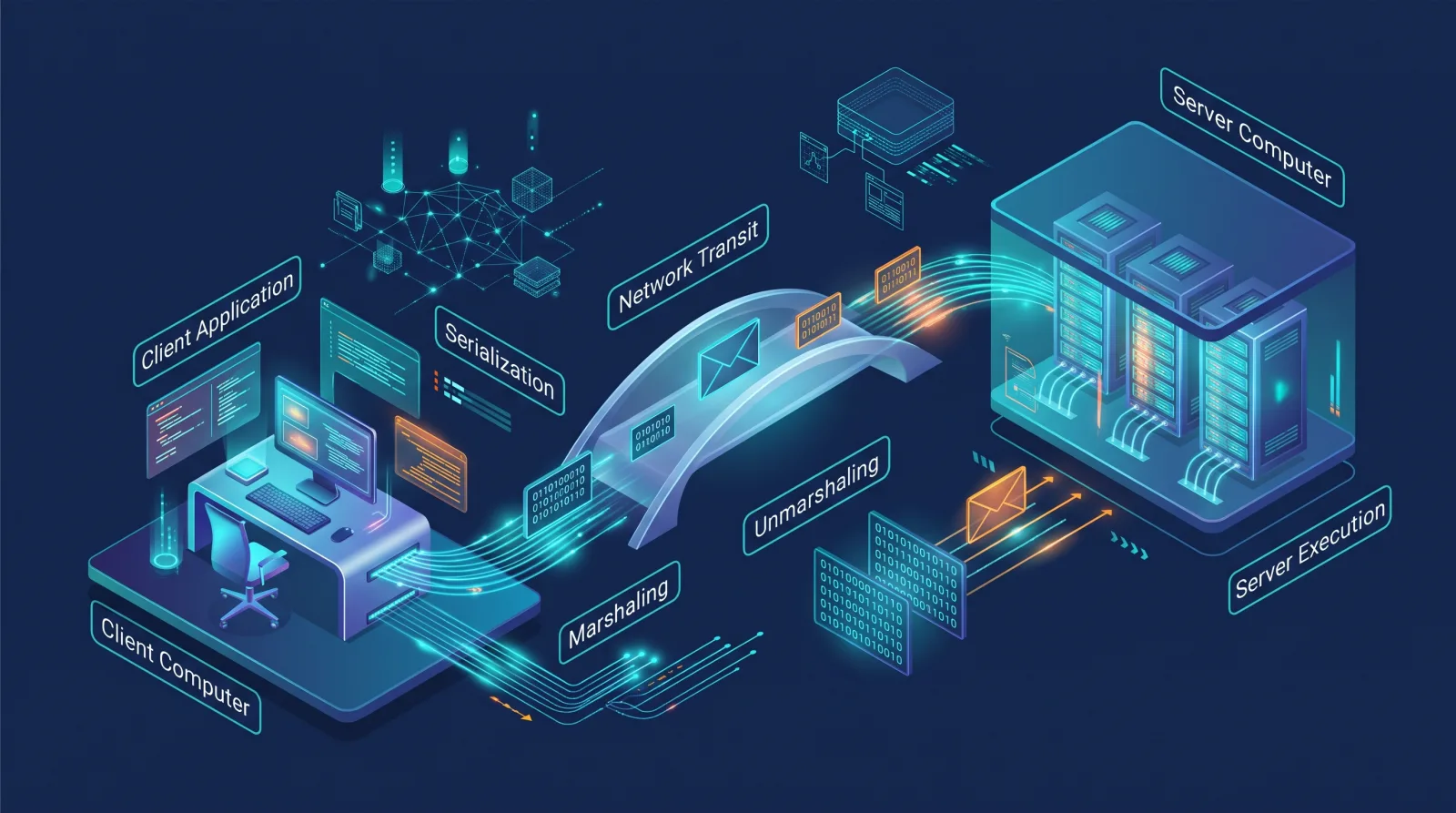
How does an RPC execute behind the scenes? In computer science, we use generated helper code called Stubs (acting as our "secretaries") to make remote interactions look like local ones.
Here is the step-by-step mechanical lifecycle of an RPC call:
- The Local Call: The Client Application calls a local function (e.g.,
calculateTax(50)). It has no idea this is a network call. - The Client Stub (The Secretary): This function doesn't actually contain the tax logic. Its sole job is to take the parameters, package them into a standardized network format (called Marshaling or Serialization), and hand them to the operating system's network stack.
- The Network Transit: The client's OS transmits these bytes across the wire via TCP or HTTP/2 to the target server.
- The Server Stub (The Dispatcher): The server's OS receives the packets and passes them to the server-side stub (often called a Skeleton). The stub unpacking these bytes back into native programming variables is known as Unmarshaling or Deserialization.
- Local Execution: The server stub invokes the actual business logic sitting on the server, gets the result, and returns it to the server stub.
- The Return Flow: The result travels the exact same journey in reverse, returning to the client application as a standard function return.
Enter gRPC: The Modern Enterprise Standard
Originally, early RPC technologies relied on heavy, slow XML/text formats. Today, global cloud companies like AWS,Netflix, and Uber use gRPC (Google Remote Procedure Call) to manage their high-speed microservices.
gRPC is incredibly fast and highly scalable due to two core components:
1. Protocol Buffers (Protobuf)
Instead of sending bulky, human-readable plain text JSON (which is slow to parse and consumes massive bandwidth),gRPC uses Google's Protocol Buffers. You define your data structures once in a schema file (.proto), and the Protobuf compiler translates them into ultra-compact, binary-encoded payloads that parse almost instantaneously on the server.
2. HTTP/2 Transport
While traditional APIs rely on old HTTP/1.1 connections (where only one request can be processed at a time per connection), gRPC utilizes HTTP/2. This allows for full bidirectional streaming, multiplexing (sending dozens of requests simultaneously over a single network socket), and aggressive binary header compression.
When to Use RPC vs. REST?
While RPC is the champion of internal cloud communication, it isn't always the right tool for every job. Here is how they compare:
- gRPC / RPC: Best for Service-to-Service (internal microservices) communication where performance, low latency, and low CPU overhead are critical.
- REST / JSON: Best for External-facing public APIs (clients to servers) where human-readability, browser compatibility, and standard URL structures are more important than raw speed.
Comments (0)
Sign in to join the conversation.
No comments yet. Be the first to share your thoughts.