
Introduction: The Scale That Shattered Databases
Not too long ago, "Big Data" was a buzzword. Today, it is an everyday business challenge. Global platforms process billions of clicks, search queries, sensor signals, and transactions every second.
When the size of a dataset reaches hundreds of terabytes or petabytes, traditional relational databases (like MySQL or PostgreSQL) hit a wall. They cannot scale beyond the physical boundaries of a single, highly expensive motherboard.
To solve this, in the early 2000s, engineers realized they had to move from vertical scaling (buying a bigger server) to horizontal scaling (connecting hundreds of standard, "commodity" computers into a cluster).
However, writing software that coordinates calculations across a cluster is notoriously difficult. That challenge birthed the first giant of the Big Data era: Hadoop MapReduce.
The MapReduce Revolution: Harnessing the Power of a Cluster
In 2004, Google engineers introduced MapReduce, which later became the foundation of Apache Hadoop. This programming model was groundbreaking because it did something very simple: it brought the calculations directly to the data (a principle known as Data Locality).
Instead of trying to move a massive 1-terabyte file over a slow network to a processing node, MapReduce leaves the data exactly where it sits on the hard drives of individual computers in the cluster. It then schedules tiny, lightweight computation jobs to run directly on those machines.
The work is split into two main steps:
- Map: Each computer in the cluster is given a tiny "slice" of the massive dataset (an Input Split). It scans its local slice, extracts the key information, and generates intermediate key-value pairs. This happens completely in parallel across thousands of nodes.
- Reduce: The cluster reorganizes these intermediate results (the Shuffle & Sort phase) so that all pieces of data with the same key are sent to the same computer. That machine then summarizes, aggregates, or reduces them into a final consolidated answer (for example, a total word count or average score).
A Real-Life Analogy: The Global Currency Counter
Imagine a global bank that needs to count a mountain of physical cash (millions of banknotes) scattered across Islamabad,Lahore, and Karachi.
- The Old Centralized Way: The bank packs all the cash into armored trucks and drives it across the country to a single central vault in Lahore, where one counting machine tries to process the entire pile. This creates transport bottlenecks, takes forever, and is vulnerable to single-point failures (if the central machine breaks, counting stops).
- The MapReduce Way: The bank hires local staff in each city. A manager tells the staff in Islamabad, Lahore, and Karachi to count their own cash locally and group the bills into smaller stacks by currency (USD, PKR, EUR)—this is the Map phase.
- Each city then mails only their small, summarized count sheets to three specific regional managers—one who collects all the USD counts, another for PKR, and another for EUR (the Shuffle phase).
- Those three managers quickly add up the small lists they receive to get the final bank total (the Reduce phase)[cite:5, 8].
The Hard Disk Bottleneck: Why Hadoop Faded
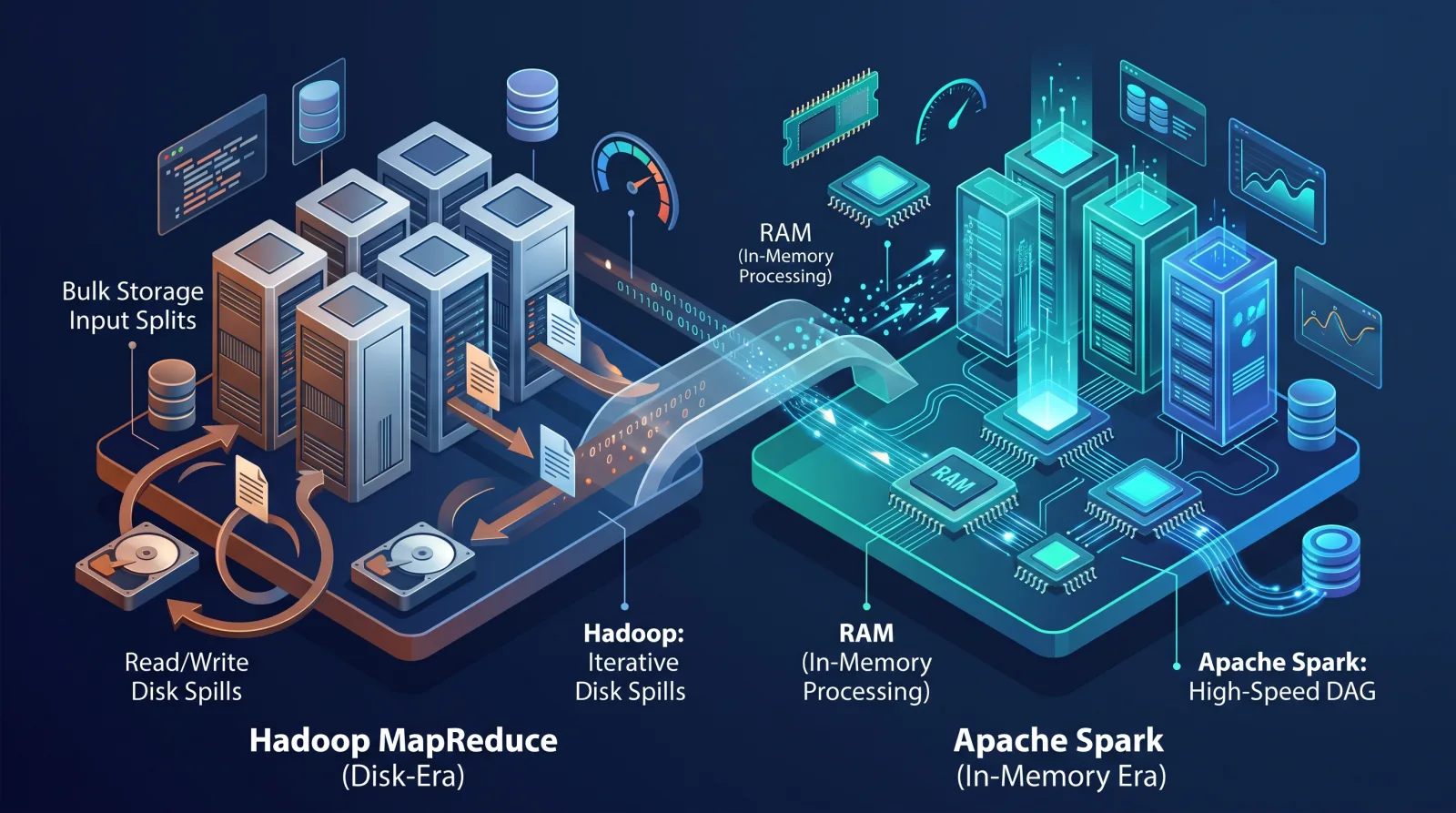
While MapReduce was incredibly resilient and capable of processing petabytes of data, it was plagued by one severe physical limitation: It was heavily bound to local hard disks.
Because hardware can fail at any moment in large clusters, the MapReduce framework makes sure it never loses data by writing its intermediate results directly to local hard disks after every single stage.
While this prevents data loss, it means the entire system has to continuously wait for slow read/write processes.
For iterative tasks (like running machine learning algorithms, which require reading and analyzing the same dataset over and over), MapReduce would perform a slow cycle of reading from disk, calculating, writing to disk, and repeating[cite:5, 8]. This made complex data science jobs agonizingly slow.
Enter Apache Spark: Bringing Lightning Speed to Big Data
In 2009, researchers at UC Berkeley developed Apache Spark to bypass the hard disk entirely.
Instead of writing intermediate results back to disk, Spark uses In-Memory Computing. It keeps datasets in the physical RAM of the cluster’s machines using a special abstraction called Resilient Distributed Datasets (RDDs).
This shift revolutionized the Big Data landscape:
- 100x Faster: By keeping data in-memory, Spark avoids the slow, constant disk reads and writes. Iterative algorithms that used to take hours on Hadoop MapReduce can finish in minutes on Spark.
- Dynamic Graphs (DAGs): Unlike MapReduce's rigid two-stage (Map →→ Shuffle →→ Reduce) process,Spark evaluates your data query and builds a custom Directed Acyclic Graph (DAG). It analyzes the entire pipeline, optimizes the execution stages, and runs multiple operations together in one pass.
- Lineage Over Disk Spills: What happens if a server in the cluster crashes and some of the data held in its RAM is lost? Rather than reading everything from disk, Spark uses an "RDD Lineage" graph—a record of the exact transformations used to create the lost data. It simply re-runs only the missing calculations on a surviving machine, restoring the lost data in seconds.
Summary: Disk vs. RAM
- Hadoop MapReduce: Best for slow, massive, non-time-critical batch processing jobs where the sheer volume of data is too large for RAM and data must be written to disk for safety.
- Apache Spark: The modern enterprise choice for real-time analytics, machine learning, and iterative data processing where speed and in-memory execution are paramount
Comments (0)
Sign in to join the conversation.
No comments yet. Be the first to share your thoughts.